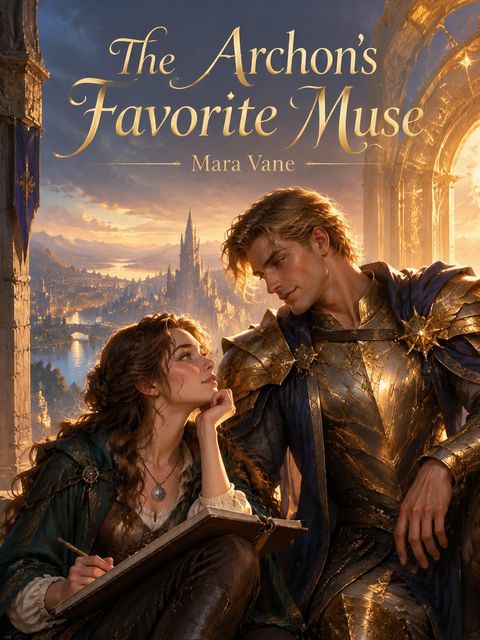
Chapter 4
“Papers,” the sergeant barked, his eyes scanning Master Corvus’s shivering troupe.
Corvus produced a crumpled imperial permit stamped with the Lord Chamberlain’s wax seal. “Performers for the Winter Dais, Captain! Jugglers, acrobats, and two voices to sing the King’s high deeds in the lower banquet!”
The sergeant barely glanced at the paper. His gaze swept the performers, lingering on the acrobats’ patched hose, the contortionist’s painted face, and finally stopping on me.
I dropped my chin. I slumped my shoulders forward, letting a string of unwashed brown hair fall across my cheekbone, curving my spine into the servile crouch of a beaten cur.
“The girl,” the sergeant said.
My heart didn't race. When you have spent three years watching the doom of the world inch forward in millimeters, a mortal sword loses its power to terrify.
“Lute,” I muttered, unstrapping the canvas case with slow, clumsy fingers. “I play the treble, ser.”
“Draw back your hood.”
I peeled the damp wool from my forehead.
The sergeant took a half-step closer. His eyes were hard, pale gray, the color of pond ice. For a terrifying, suspended second, I thought he saw past the dirt smeared across my cheek, past the stained collar and the hollows beneath my eyes. Three years ago, this man might have stood guard outside my council chamber. He might have presented arms when I entered the throne room draped in swan-ermine and mother-of-pearl.
Then he looked at my hands.
The delicate skin of a princess was gone. In its place were the rough, yellowed callouses of a minstrel, crisscrossed with tiny white scars where steel strings had snapped against flesh. My knuckles were red and swollen from the mountain freeze.
“Sing something,” the sergeant commanded.
“Ser?”
“You claim you’re a voice for the King’s deeds. Sing a measure. Now.”
The other performers held their breath. Corvus shot me an anxious, sweating glare, silently begging me not to ruin our entry into the warm hall.
I didn't reach for the soft melodies of the court. I didn't touch the silk-smooth cadences of the old romances. I struck a single, biting chord on the low octave—the harsh, marching meter of the Vanguard itself:
*“Iron in the stone, ash upon the spear,* *The watchman keeps the gate while the shadows draw near.* *He takes no bride, he drinks no wine,* *He burns his blood upon the line.”*
The chord hung in the vaulted archway of the gate, vibrating against the stone with an unnatural, ringing clarity that made two horses in the baggage line prick their ears.
The sergeant’s jaw tightened. A flicker of something raw and deeply wounded crossed his weathered face—a soldier recognizing the hymn of his own grave.
He lowered his hand.
“Enter,” he said, his voice dropping an octave. “Keep to the Lower Bailey until summoned. If any of you wanders toward the Inner Spire, you’ll hang from the wall before sunrise.”
“Bless you, Lord Commander,” Corvus bleated, practically shoving our cart through the iron-toothed teeth of the inner gate.
As we rattled into the cobblestone courtyard of Oakhallow, I pulled my hood back over my brow and let out a slow, frosty breath.
I was inside.
***
The palace was not weeping. It was gorging itself.
While the provinces starved under harsh emergency levies and the mountain passes cracked with ley-quakes, the Great Hall of Oakhallow blazed with unhinged, desperate splendor.
Thousands of beeswax tapers dripped gold into silver sconces. Long trestle tables groaned under roast stags with gilded antlers, sugar-spun towers depicting the mythical conquest of the Northern Reaches, and vats of spiced red wine that steamed in the chilly draft from the high clerestory windows.
Lords in ermine-trimmed surcoats laughed too loudly, their cheeks flushed with drink. Ladies with powdered throats and towering coiffures fluttered mother-of-pearl fans, whispering behind their fingers, glancing nervous, sideways looks at the dais at the far end of the hall.
They were afraid, I realized as I tucked myself into the shadow of a stone buttress near the musicians’ gallery.
They ate like condemned men eating their final meal. Every courtier in that room had felt the earth shake in its sleep; every duke knew that the grain reserves in the western silos were being hoarded by royal decree for reasons no one would explain. But instead of revolting, they clung to the illusion of peace, desperately worshipping the monster who kept the dark away.
*“Three years of peace,”* an old marquess near my pillar sneered into his goblet, his voice dripping with venomous relief. “He may be a low-born dog who stole the crown, but by God, the borders are shut and the raiders haven't crossed the river. If the tyrant wants to hoard the silver, let him. Better a silent tyrant than a weeping girl on the throne.”
I adjusted the strap of my lute against my shoulder, feeling no anger at his words. Only an infinite, crushing weariness.
They had no idea what sat above them.
My eyes drifted toward the dais.
The High Seat of Wraithmark—the throne my grandfather had carved from the heart of the southern mountains—sat upon five tiers of black basalt. But tonight, it was obscured.
Heavy, gossamer-thin curtains of black silk hung from iron rods suspended from the high ceiling, cloaking the entire dais in a shimmering, impenetrable shadow. Behind that veil, a faint silhouette sat utterly motionless, flanked by two towering brazier-fires that threw off no warmth, only an unnatural, violet-tinted smoke that smelled faintly of ozone and burning bone.
Galen.
My knuckles tightened against the wood of my lute until the spruce creaked.
Ten years ago, he had not been a silhouette behind black silk.
He had been sixteen, his hair wild and ink-black, his shoulders too wide for the hand-me-down mail hauberk he wore in the royal armory.
*“Princesses shouldn’t hold steel,”* he had told me then, his knuckles bleeding from four hours of sword practice in the sleet, his gray eyes flashing with fierce, protective insolence. *“Steel is heavy. It bites back. Go inside and play your harp.”*
*“I’ll hold whatever I please, Galen Vance,”* I had snapped back, barely fourteen, lifting a wooden practice blade with both hands and striking him squarely across his broad chest. *“And when I am Queen, you will kneel when I tell you to kneel.”*
He hadn't knelt. He had caught the wooden tip between two calloused fingers, twisted it from my grip with effortless grace, and stepped into my guard until I could feel the heat radiating off his soaked tunic.
*“When you are Queen,”* he had murmured, his voice dropping into that quiet, terrifying timber that only I ever heard, *“I will stand between you and the dirt. That is my only vow.”*
He had kept it. With terrifying, monstrous fidelity, he had kept it.
Three years ago, on the night the stars died over Oakhallow, I had found him in the high library.
He hadn't been wearing his armor. He had been surrounded by ancient scrolls—the forbidden annals of the First Covenant, written in the dead tongue of the dragon-priests. His face had been pale, his mouth set in a thin, bloodless line.
*“Galen?”* I had asked, stepping into the pool of candle-light. *“The council meets at dawn. The tremors in the western rift are spreading. We must invoke the sovereign rite.”*