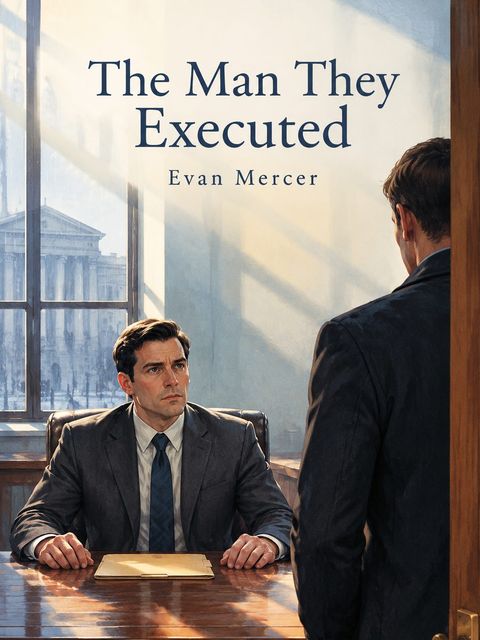
Chapter 1
A broken brain cannot lie, which was precisely why Senator Bradford paid twenty thousand dollars a month to keep mine monitored. Every grunt, every puddle of spilt soup, and every nocturnal tremor recorded in Room 14 of the Kirkwood Rest Home was transcribed for his eyes only. For fourteen years, state neurologists signed off on my slow, irreversible rot. And for fourteen years, I gave them only seven numbers, muttered through slack lips and vacant stares. Bradford believed those digits were the dying embers of my sanity—the only coordinate that could finally bring him out into the dark.
The oatmeal was cold, coated with the translucent skin that forms over boiled starch when it sits too long in air-conditioned air.
Miller drove the plastic spoon into my lower lip. He didn't do it out of malice; he did it with the mechanical impatience of an orderly who had eight more rooms to service before his smoke break.
"Open up, Artie," he muttered. "Come on, old horse. Chew, don't swallow whole. We don't need another bronchial suction today."
I let my jaw hang slack. The left side dropped lower than the right, a millimeter past the natural resting point of a healthy temporomandibular joint. To maintain that asymmetry for twelve hours a day required clenching the pterygoid muscle inside the right cheek while letting the left facial nerve cluster go utterly dead to the world. It caused a dull, blinding ache that radiated from behind my ear down into my collarbone, but pain was simply data. Data could be filed away.
The spoon shoved past my gums. The glop hit my tongue—bland, salty with tap water, tasting of old stainless steel.
I did not swallow. Instead, I allowed my eyes to uncouple.
Normal eyes track motion together; they dart toward an approaching shadow or a sudden sound. A brain ravaged by multi-infarct dementia loses that smooth pursuit. I let my left pupil drift outward toward the corner of the Lexan window, fixed on the gray drizzle sliding down the glass, while my right pupil stared straight into the third plastic button of Miller’s polyester scrub top.
A blob of gray cereal rolled over the edge of my bottom lip and slid down into the creases of my neck.
"Jesus, Artie," Miller grunted, snatching a rough paper towel from his back pocket and scraping it against my skin until the flesh burned. "Fourteen years of this shit. You'd think your tongue would remember how to push backward."
"Four," I whispered.
The word was not shaped by the lips. It came from the back of the throat, wet and choked with phlegm, sounding like a dying refrigerator kicking on in an empty room.
Miller stopped scraping. His wrist stayed frozen against my neck for two seconds.
"What's that?" he asked softly.
Above the door, nestled inside the housing of what looked like an ordinary Honeywell smoke detector, the tiny red pinhole of an infrared optical lens adjusted its focal ring with a faint, high-frequency squeak. Senator Bradford’s private security firm in Bethesda didn't rely on Kirkwood’s municipal nursing logs. They paid for forty-eight frames per second, uncompressed audio, and an algorithm that flagged any vocalization exceeding thirty decibels.
"One," I muttered. My head rolled sideways, striking the padded vinyl headboard. A string of saliva caught the light. "Eight."
Miller dropped the plastic spoon into the styrofoam tray. He didn't finish feeding me. He never did once the string started. He reached into his pocket, pulled out the laminated dry-erase clipboard provided by the attending physician, and uncapped a marker with his teeth.
"Four, one, eight," Miller repeated under his breath as he scribbled. "Go on, Artie. What's after the eight?"
I closed my eyes. The lid of my left eye fluttered in a ragged, asymmetrical tremor—three twitches every five seconds, the hallmark of deep-seated ischemic tissue in the thalamus. I let the silence stretch until Miller leaned in close enough for me to smell the stale coffee and burnt tobacco on his breath.
"Zero," I exhaled. "Nine."
He wrote it down. His hand was shaking slightly. It happened every time. For fourteen years, the staff had turned over seven times, but the instructions left behind by Dr. Keller—Bradford’s handpicked chief of neuro-geriatrics—remained taped to the nurse’s station desk: *Any spontaneous numerical sequence spoken by Resident Vance must be transcribed verbatim and reported immediately to Extension 404. Do not prompt. Do not interrupt.*
"Two more, Artie," Miller coaxed, his voice dropping into a conspiratorial whisper. "Finish it up so I can get your sponge bath done."
I didn't give him the two. A truly ruined brain does not obey commands; it runs on broken circuits that stall without warning. I let my jaw go slack again, let my chest sink into the shallow, irregular breathing of a man slipping into a micro-stroke, and stared through him.
Miller cursed under his breath, capped the marker, and gathered the tray. "Useless old bastard," he muttered, turning his back on me. "Five numbers. You missed the tail again."
The heavy fire door clicked shut behind him, the magnetic lock engaging with its familiar pneumatic hiss.
Alone in Room 14, I kept my eyes unfocused on the rain.
I did not blink. I counted thirty-six beats of the digital wall clock, allowing the tears of dry cornea exposure to well up and spill over my lower lids, before I permitted my lungs to draw a single, deep, silent breath through my nose.
Five numbers today. Yesterday, three. Last Thursday, all seven, gasped out in the middle of a staged grand mal seizure that had three nurses wrestling to jam a bite-guard between my teeth.
*4 - 1 - 8 - 0 - 9 - 5 - 2.*
Seven digits. Not a telephone number. Not a bank account. A coordinate format used only by the United States Geological Survey before the state digitized its forestry records in the late nineties.
A coordinate that pointed to seventy acres of poison oak, flooded slate quarries, and rotting hemlock in the Blackwood basin.
A coordinate that did not contain what Richard Bradford thought it contained.
***
In the spring of my forty-first year, I had been the Chief Archivist for the Commonwealth.
It was a quiet, gray profession, populated by people who wore cotton gloves and spoke in hushed tones about acid-free paper, deacidification baths, and microfiche preservation. I liked paper. Paper had physical weight; it decayed according to predictable chemical laws; it could not be rewritten by an administrative keystroke in the middle of the night.
Paper was where men like Richard Bradford made their mistakes.
Fourteen years ago, Bradford was not the senior senator from Pennsylvania, not the silver-haired lion appearing on Sunday morning talk shows, and not the rumored frontrunner for the vice-presidential ticket. He was a county commissioner with a real estate trust, an appetite for strip-mine land reclamation grants, and four million dollars in unaccounted industrial development bonds.
The paper told the story. Not in one grand confession, but in the mundane discrepancies: hauling manifests that didn't match weigh-station stamps; duplicate environmental assessment forms signed by inspectors who had died two months prior to the date of execution; land deeds transferred to shell corporations registered to a post office box in Grand Cayman.