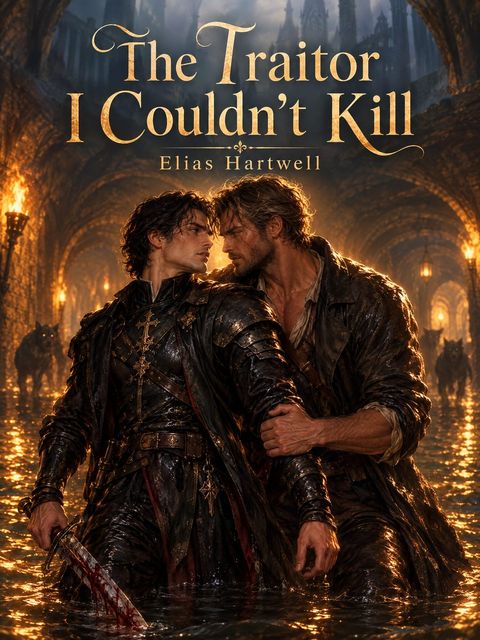
Chapter 2
“Speak louder,” he murmured.
I frowned. “What?”
“I said, don't mumble, Julian. Your voice gets lost in all this paper.” His sneer was instantaneous, a practiced mask snapped over his face before I could parse the strange hesitation in his posture. “You talk like you’re trying to keep a secret from the books.”
“I’m speaking at my normal volume,” I said, enunciating every syllable with crisp, hostile clarity. “And you didn't answer my question.”
“The Blackwood collection,” he said.
The name hit the quiet room like a dropped lead weight.
I stared at him. “The Blackwood archive? Lord Blackwood died two months ago. The estate was locked in probate. The National Library was petitioning for custody.”
“The National Library petitioned,” Vance said, stepping forward again. This time, his boot came down flat, hard, and unmistakably heavy against the pine floorboards, closing the gap between us until the hem of his coat brushed my apron. “I offered immediate liquidation. The heirs were greedy, Julian. They didn't want their grandfather's damp vellum locked in a public vault with thirty-year annuities. They wanted gold. They wanted draft notes drawn on the Lombard exchange.”
“You bought it,” I whispered, horrified and grudgingly stunned. “The entire fourteenth-century cartographic holding?”
“Every parchment. Every marginal note. Every hand-drawn coastal survey commissioned by the merchant guilds before the great fire.” Vance smiled, a sharp, brilliant baring of teeth that was meant to crush me, meant to remind me of where he stood in the firmament of the antiquarian trade. “Three hundred items. Untouched for nearly two centuries.”
“You don’t have the staff to conserve that,” I snapped, my collector’s heart beating frantically against my ribs despite my hatred for the man holding the prize. “Cartographic vellum from that era is notoriously unstable. If the sizing is flaking, if there’s red rot in the bindings—one wrong climate shift will crumble the coastlines into dust!”
“I know.”
“You don’t know anything about conservation! You know auctions! You know provenance and insurance valuations and how to flatter dowagers into parting with their family heirlooms!”
“Which is why,” Vance said, leaning down toward me so sharply that I instinctively took a half-step back, only to hit the heavy oak frame of my standing press, “I came here.”
My spine pressed flat against the polished oak. Vance followed the movement instantly, closing the distance as if drawn by a magnet. He put his right arm up, his gloved hand bracing against the upright timber of the press, barely two inches from my left ear.
He had me pinned.
The heat coming off him was staggering. Up close, I could see the minute tremors running through the muscle of his forearm. His shoulder leaned heavy into the wood, bearing down with an astonishing amount of weight, as if the press—and by extension, the space I occupied—was the only solid thing in the room.
“You’re insane,” I breathed, staring directly into his dark, dilated pupils. “You think I’m going to pack my tools and follow you back to the city like a court scribe?”
“Not to the city,” Vance said, his voice dropping to a harsh, gravelly whisper. “The collection is here. At Blackwood Hall. On the headland.”
“The manor is condemned.”
“The manor is private property. Leased to my firm for the next three weeks.” Vance didn't blink. He stared at me with that strange, unblinking fixation, his face barely eight inches from mine. “I need a binder. I need the best restorer on this coast. And for all your sanctimonious posturing, Jules, you’re the only person I trust not to ruin the ink.”
Hearing him use that old, hated nickname—*Jules*, the name he used to whisper across the ink-stained desks at midnight when we were boys competing for the same fellowship—sent a jolt of raw, electric tension straight down my spine.
“Don’t call me that,” I said, my teeth clenched.
“Then tell me you won’t look at them,” he challenged, his breath brushing the curve of my cheek. “Tell me you don’t want to touch the 1342 Mercator precursor. Tell me you’d rather stay here, re-backing third-edition hymnals for the parish vicar, while I let some clumsy London apprentice slice the vellum off the boards.”
He knew exactly where to twist the knife. He always had.
“You arrogant bastard,” I muttered.
“Undoubtedly,” he agreed without a drop of shame. But even as he said it, even as the triumphant swagger rolled off his words, his other hand—his bare left hand—reached out blindly.
It didn't grab the press.
His fingers brushed the rough linen of my apron, fumbled slightly against the seam of my waist, and then clamped down onto the fabric of my forearm. His grip wasn't a threat; it wasn't a lover’s caress. It was frantic. His thumb dug deep into the muscle beneath my rolled-up sleeve, gripping me with an intensity that bordered on painful.
I stiffened. “Vance. Let go of my arm.”
He didn't let go. His fingers remained locked around my flesh, anchoring him to me as if the oak floorboards beneath his feet had suddenly turned to liquid.
“Julian,” he said. The mockery had vanished from his tone, replaced by an odd, hollow tightness. “Say something else.”
I blinked, thrown off balance by the sheer absurdity of the request. “What?”
“Say something. Keep talking.”
“Why are you acting like this?” I demanded, trying to pull my arm back. He didn't release me; his grip tightened, dragging him an inch closer, his chest nearly touching mine. “You come in here, throwing your weight around, insulting my life, and now you’re clinging to my sleeve like a child in a thunderstorm.”
A sharp, ragged breath slipped past his lips. He swallowed hard. The muscle in his jaw jumped, once, twice.
“I’m not clinging,” he rasped, though his fingers didn't yield a millimeter. “I’m making sure you understand the terms.”
“The terms of what? Your royal summons?” I shoved my free hand against his chest, intending to push him back into the open shop. My palm flattened against the heavy, damp wool of his coat, right over the thunderous, erratic hammer of his heart.
He was trembling.
It was almost imperceptible—hidden beneath the thick fabric, masked by the sheer breadth of his shoulders and the unyielding arrogance of his stance—but it was there. A high-frequency, shuddering vibration that ran through his entire torso.
The shock of it made me hesitate. “Vance?”
He squeezed his eyes shut for a fraction of a second—a violent, spasming blink—and when he opened them, the cold, razor-edged sneer was back in place, bright and venomous.
“Ten thousand,” he said, his voice rising, projecting toward the rafters with that theatrical, metropolitan cadence. “Gold on deposit. Full access to the Blackwood library. Your name on the monograph as co-curator.”
He let go of my arm so abruptly it felt like a slap.
He didn't step back smoothly. When his hand dropped, his body swayed—just a fraction of an inch to the left—before his right boot struck the floor with a loud, deliberate *thud*, re-centering his balance with exaggerated force. He immediately gripped the wooden corner of the binding table, leaning heavily on his palms as if examining the brass tools laid out on the felt.
On iPhone, notifications need PulpTale on your Home Screen:
1. Tap the Share button in Safari, then "Add to Home Screen".
2. Open PulpTale from your Home Screen and we'll ask again.