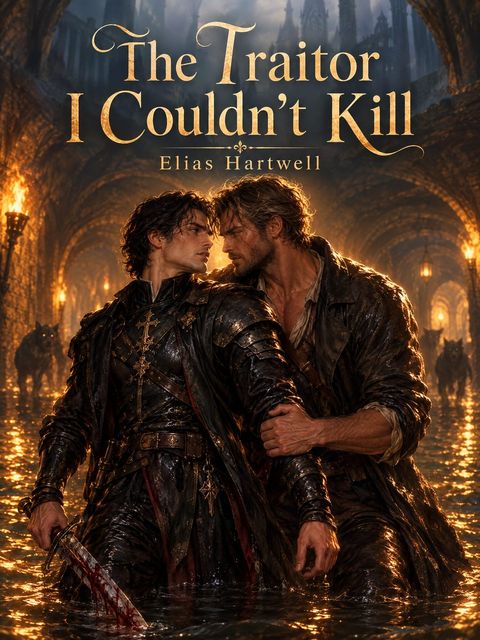
Chapter 1
A single drop of dark ink bloomed across the corner of their forged alibi, right where Arthur’s calloused thumb pinned the parchment to the table. Julian watched it spread, fighting the ridiculous urge to press his own fingers over Arthur’s. In the gallery box, Lord Sterling watched them like a hawk admiring his caged fighting dogs. They were supposed to present a united front, but Arthur’s knuckles were white with tension, and his jaw was set with a fury Julian knew too well. “Sign it,” Julian whispered, voice strained. “Sign it and pretend you don't want to tear my throat out.”
Arthur didn’t sign. Instead, he dragged the quill backward, the nib catching the grain of the vellum with a sickening, fibrous scratch that set Julian’s teeth on edge.
“I’m considering whether the noose might actually be quieter than your voice, Counselor,” Arthur muttered under his breath, his voice like gravel ground between millstones.
Julian’s breath hitched in his chest, a painful, hot throb beneath his stiff woolen waistcoat. He reached out with ink-stained fingers, ostensibly to steady the document, but his knuckles brushed Arthur’s wrist—broad, scarred, burning hot against the damp chill of the subterranean courtroom. For a fraction of a second, Arthur’s pulse leaped against Julian’s skin, wild and feral. Then Arthur yanked his hand away as if scalded, glaring at the dark grain of the defense counsel’s bench.
“Do not touch me,” Arthur hissed, low enough that only the bailiff standing three paces behind could hear the venom, if not the words.
“Then do your bloody duty for once in your miserable life,” Julian snapped back, his voice pitched to carry just far enough into the gallery to register as frayed desperation. “Sign the affidavit, Captain. Unless you prefer the King’s irons around your neck by nightfall.”
From the velvet-draped box on the north wall of the gallery, three floors above the flagstones, a cane tapped softly against the mahogany rail. *Tuk. Tuk.*
The sound went straight through Julian’s skull. He didn’t need to look up to feel Lord Sterling’s presence. Sterling sat like an ivory spider in his high seat, swathed in winter sable despite the muggy stench of three hundred unwashed spectators packing the public benches. For three weeks, Sterling had held their leashes. He had supplied the bribes, the forged travel logs from the Northern border, the very clothes on Julian’s back—a dark barrister’s robe that hung slightly too loose on Julian’s diminished frame.
*‘A second chance, my dear boys,’* Sterling had purred in his private study behind the Admiralty, pouring brandy into crystal goblets neither of them had touched. *‘The Crown demands a sacrificial lamb for the disaster at Blackwater Marsh. But a brilliant legal mind and a decorated scout need not perish over a clerical misunderstanding. Take my papers. Swear by them. Give the bench a tidy narrative, and I shall see you both restored.’*
Benevolence from an arch-patron. Lifeline from heaven.
And yet, looking at Arthur now, Julian felt only the cold, sharp edge of a blade pressed against his windpipe.
“You’ve ruined the bottom margin,” Julian whispered harshly, dabbing at the blot with a folded handkerchief. His hands shook. It was not entirely an act. The air in the High Court smelled of damp wool, tallow candles, and fear. “Arthur. Look at the bench. Justice Vance is taking his seat. If you falter now—”
“I don’t take orders from a man who deserted his post before the mud was even dry,” Arthur growled, his golden-brown eyes flashing with a fury so raw it seemed capable of igniting the parchment between them.
The words struck Julian like an open palm across the face. A dozen spectators in the front row leaned forward, their eyes gleaming at the scent of blood between co-defendants. Three years ago, when the regiment had been ambushed and slaughtered at Blackwater, Arthur had been left in the marsh with broken ribs and a shattered knee, while Julian—stationed at the divisional records tent—had arrived at headquarters with missing dispatch bags and blood on his collar. By morning, they were both cashiered, stripped of commission, their names dragged through the London broadsheets as traitors and cowards who traded military intelligence for gold.
They had been lovers then. Secret, reckless lovers who shared cots in drafty campaign tents, breathing each other’s skin in the dark before dawn patrols.
Now, they were pariahs bound by iron chains and mutual loathing, standing before the highest tribunal in the realm on charges of grand treason and conspiracy against the Crown.
The heavy oak doors at the front of the chamber groaned open.
“Oyez, oyez, oyez!” the court crier bawled, striking his staff against the dais. “All manner of persons having anything to do before our Sovereign Lord the King’s Justices of Oyer and Terminer, draw near and give your attendance!”
Chief Magistrate Vance climbed the dais, a shriveled, vulture-like man in crimson robes and horsehair wig that swallowed his withered neck. Flanking him were two junior justices and the King’s Advocate, Sir Gerald Finch—a prosecutor whose reputation had been forged on the corpses of disgraced officers. Finch was already smoothing his silk tabs, his smile as thin and cold as a razor.
“Be seated,” Vance croaked.
A rustle swept through the gallery as hundreds of bodies settled into benches.
Julian remained on his feet, his robes heavy around his shoulders. He felt Arthur rise beside him, tall and rigid as an iron pike. Arthur had always towered over him, his shoulders broad from years in the saddle, his jaw shadowed by dark stubble that no shave could entirely tame. In the close quarters of the defense enclosure, the heat radiating off Arthur was an agonizing torment. Julian could smell the lye soap on Arthur’s coarse linen shirt, the faint scent of rain and old leather—familiar scents that clawed at Julian’s ribcage, begging for a past that had burned to ashes.
“The case of the Crown against Julian Vance—no relation to the bench—and Arthur Thorne,” the clerk intoned, unrolling a ribboned scroll. “High Treason, seditious correspondence with foreign powers, and illicit conversion of military funds.”
Sir Gerald Finch rose smoothly from the prosecution table, bowed to the bench, and cast a pitying glance at Julian.
“My Lords,” Finch began, his voice melodic and resonant, echoing off the stone vaults. “We stand here today to conclude an inquiry that has festered like an open wound upon this nation’s honor. Three years past, the Third Hussars and the Fifth Scouting Corps were cut down at Blackwater Marsh. Two hundred sons of the realm dead. And who survived? The company quartermaster, Mr. Julian Vance, and his forward scout, Captain Arthur Thorne.”
Finch paused, letting the murmurs rise from the gallery like locusts.
“For three years, these two men claimed the records were lost in the mire,” Finch continued, pacing before the jury box. “They claimed the funds were captured by enemy raiders. Yet we are presented today with a curious artifact—an affidavit, delivered mere hours before this session, claiming that both defendants were not even present at the field depot during the critical hour of the surrender! They claim they were thirty miles west, delivering dispatches to an auxiliary garrison under the seal of the War Office.”